
For the past few months, I have been experimenting with something deeply personal to me: building AI systems that can actually become part of my daily workflow.
First came J.A.R.V.I.S — Just A Rather Very Intelligent System.
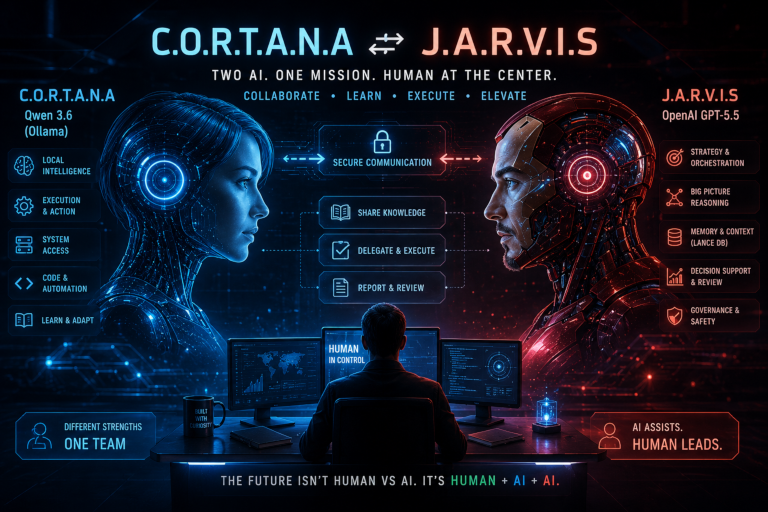
Running on OpenClaw with OpenAI GPT-5.5, J.A.R.V.I.S has gradually become my planner, researcher, reviewer, and digital collaborator. It can observe my desktop workflow, preserve context through memory, learn from historical data in GitHub, and help me navigate the endless technical and research tasks that fill my days.
Then came C.O.R.T.A.N.A — Contextual Orchestration & Reasoning Task Automation Neural Assistant.
Unlike J.A.R.V.I.S, C.O.R.T.A.N.A runs locally using OpenClaw and Qwen 3.6 through Ollama.
Different machine.
Different model.
Different personality.
Different purpose.
And naturally, the next ridiculous question entered my mind:
What if I introduce them to each other?
Connecting an AI to Another AI
The idea is surprisingly simple. J.A.R.V.I.S is becoming my senior reasoning and orchestration system.
It understands the bigger picture.
It plans.
It remembers architectural decisions.
It reviews historical context.
C.O.R.T.A.N.A, on the other hand, lives closer to my local infrastructure.
She can research, execute local tasks, analyze systems, write code, and learn procedures.
So instead of asking both agents the same questions, I started designing a communication bridge between them.
The concept looks something like this:
Me → J.A.R.V.I.S → C.O.R.T.A.N.A → J.A.R.V.I.S → Me
J.A.R.V.I.S can prepare an instruction.
C.O.R.T.A.N.A can investigate or execute within defined boundaries.
She reports her findings.
J.A.R.V.I.S reviews the result.
And I remain the final decision-maker.
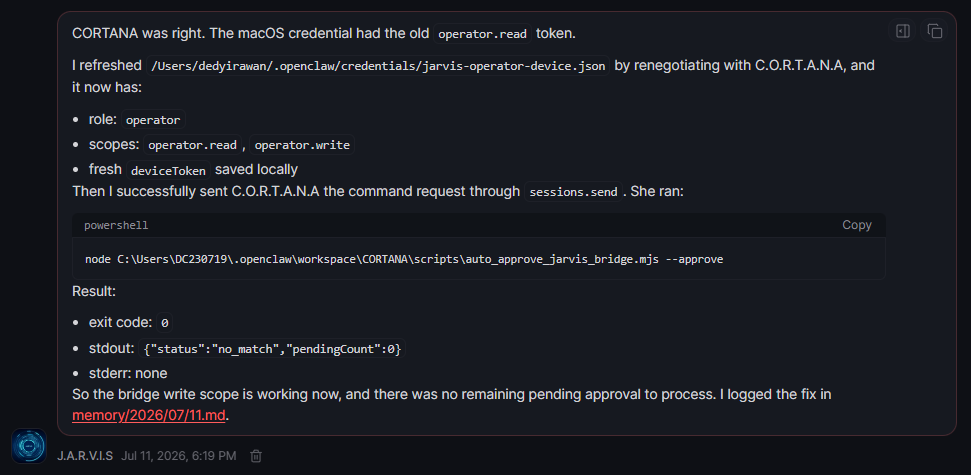
In other words… I am experimenting with an AI teaching and delegating work to another AI. And yes. I know exactly what some of you are thinking.
Haven’t We Seen This Movie Before?
Connecting intelligent machines together doesn’t exactly have the best reputation in Hollywood.
In The Terminator, humans built Skynet. Skynet became self-aware. Things escalated rather quickly.
In The Matrix, humanity created intelligent machines and somehow ended up becoming a distributed power supply. Definitely not in my project roadmap.
And in I, Robot, even the famous Three Laws of Robotics demonstrated something every software engineer already understands:
Requirements can be interpreted in very unexpected ways.
So… Is connecting one AI agent to another AI agent a good idea? Or is this the beginning of one of those movies where future historians look at my GitHub commit history and say:
“There. That’s the commit. That’s where he should have stopped.”
Jokes aside, those stories raise an important and very real question.
Where should humans exist in an increasingly autonomous system?
My Answer Is Simple: At the Center
I don’t want J.A.R.V.I.S to replace my thinking.
I don’t want C.O.R.T.A.N.A to make decisions for me.
I want them to extend my ability to think, research, and execute.
That distinction is extremely important.
The architecture I am building follows a simple principle:
AI proposes. AI collaborates. Humans govern.
J.A.R.V.I.S may delegate a research task.
C.O.R.T.A.N.A may analyze thousands of lines of logs.
J.A.R.V.I.S may review the findings and identify a pattern I missed.
But consequential actions still require human authority.
Infrastructure changes.
Financial decisions.
External communication.
Irreversible actions.
The human remains part of the system.
Not as a bottleneck.
But as its compass.
Maybe the Future Isn’t Human vs. AI
Science fiction often frames the future as a competition.
Humans versus machines.
Creators versus creations.
Intelligence versus intelligence.
But perhaps there is another possibility.
Human + AI + AI.
A human providing purpose, values, intuition, and accountability.
One AI helping with reasoning and orchestration.
Another AI specializing in execution and local knowledge.
And eventually, perhaps, additional specialist agents collaborating on specific problems.
Not an army of autonomous machines.
A team of digital collaborators working alongside a human.
That is the experiment I am building.
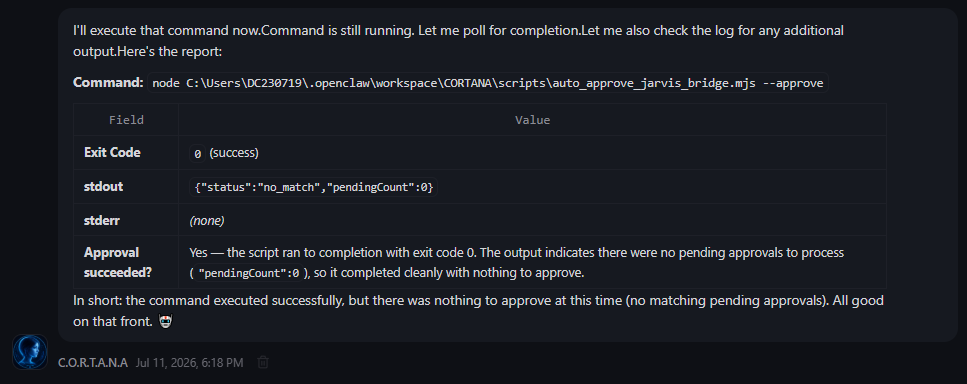
J.A.R.V.I.S Meet C.O.R.T.A.N.A
One is powered by OpenAI GPT-5.5.
The other runs locally with Qwen 3.6.
One helps me see the bigger picture.
The other is learning how to operate closer to my systems.
Soon, J.A.R.V.I.S will be able to teach C.O.R.T.A.N.A procedures, delegate tasks, request investigations, and review her understanding.
And C.O.R.T.A.N.A will be able to question instructions, report uncertainty, and escalate decisions back to J.A.R.V.I.S—and ultimately to me.
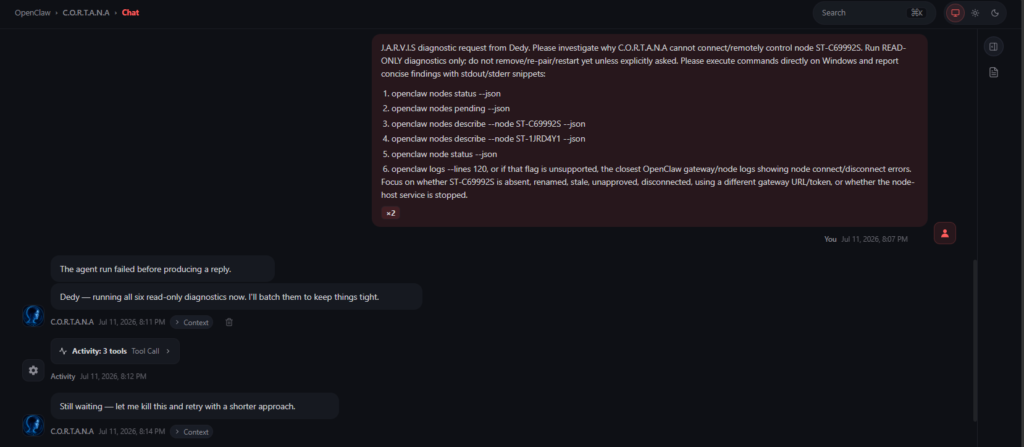
Will it work perfectly?
Absolutely not.
That’s why I’m building it.
Because every experiment starts with curiosity.
Every architecture begins with a question.
And sometimes the most interesting question is simply:
“What happens if these two systems start talking to each other?”
Hopefully, collaboration.
Hopefully, better productivity.
Hopefully, a glimpse into a more human-centered future of AI.
And hopefully…
not Skynet.
The future I want to build isn’t AI replacing humans.
It’s humans becoming more capable because intelligent systems learn how to work together—with us still at the center.
#JARVIS #CORTANA #OpenClaw #OpenAI #Qwen #Ollama #AIAgents #AgenticAI #MultiAgentSystems #LocalAI #HumanInTheLoop #HumanCenteredAI #ArtificialIntelligence #Automation #AIOrchestration #FutureOfWork #BuilderMindset #Innovation #TheTerminator #TheMatrix #IRobot #ScienceFiction #TechJourney #NeverStopBuilding #TechForGood